

By Ben Brooks, Warri
President Bola Ahmed Tinubu has declared that Nigeria has come out of its most difficult economic phase, saying the nation has “corrected its course” and “passed through its own Red Sea.”
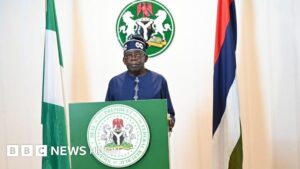
In his nationwide broadcast to mark Nigeria’s 66th Independence Anniversary on October 1, 2026, the President said the painful reforms introduced by his administration since 2023 were unavoidable.
He described Nigeria’s condition before 2023 as critical, with rising poverty and almost lost hope, caused by decades of postponed decisions and deep economic distortions.
Using a medical analogy, President Tinubu said:
> “Nigeria was like a sick patient who receives the terrible news that he has cancer. His doctor explains that the treatment will be difficult and painful, but that it offers a strong prospect of recovery… For too long, Nigeria’s leaders chose morphine while praying for a miracle that never came. They focused on symptoms while allowing the disease to take hold deep within the fabric of our society.”
“We chose to excise the cancer. The reforms that followed were difficult. The side effects were real. Yet, we must never confuse the medicine with the disease. Our reforms did not create the weaknesses in our economy. They confronted them,” he added.
Tinubu warned Nigerians against listening to what he called “influential but regressive voices” calling for a return to subsidy regimes, describing their call as a “siren song.”
The President said the emergency treatment is now over and the foundation of the economy has been repaired.
“My fellow Nigerians, we have reached a turning point. The emergency treatment is over. The foundation has been repaired. The central economic task before us has changed. For three years, our overriding purpose was to correct our nation’s course. Now, our purpose is simple: shared and widespread prosperity,” he declared.
He reeled out what he called undeniable evidence of recovery:
– Economy grew by over 4 per cent in 2026
– Oil theft is down
– Inflation has fallen substantially from its peak
– Foreign reserves rebuilt and foreign exchange market stabilized
– Non-oil exports in 2025 exceeded $6 billion, the highest in Nigeria’s history
He said international observers, NGOs and multilateral institutions have acknowledged the stability, while foreign direct investment continues to rise.
Tinubu said prosperity for him is not about abstract numbers, but personal impact.
“A Nigeria in which the farmer can cultivate his land safely, produce more at lower cost, and earn a decent return for his labour. A Nigeria in which factories have reliable power, businesses can obtain credit, and young people can find productive work. A Nigeria in which food and transportation are affordable, education is within reach, and hard-working families can look towards the future with confidence.”
To bring down the cost of living, he said government will focus on expanding mechanised irrigation and dry-season farming, improving seeds and fertiliser access, investing in storage and transportation, and completing roads, railways and ports that connect farms and factories to markets.
He also pledged to place jobs and industrial growth at the heart of policy by using gas to power new industries, reviving factories in industrial centres, expanding digital connectivity, and supporting businesses with skills and finance.
“I want to see more Nigerians making things. I want to see more Nigerian farms feeding our cities and supplying our factories. I want to see Nigerian businesses selling Nigerian goods to the whole world. I want young Nigerians building unicorns and creating opportunities for others here at home,” he said.
Acknowledging that millions still struggle for food, school fees and medical bills, Tinubu said the hardship was the accumulated consequence of decades of low productivity and weak institutions, not just the recent reforms.
He listed interventions to cushion the effects, including strengthening the National Social Register for poor households, the Nigerian Education Loan Fund (NELFUND), CREDICORP consumer credit scheme for vehicles, solar systems and digital devices, and working with states to strengthen primary healthcare and basic education.
He concluded with a call for unity and forward movement:
“Nigeria has corrected its course. We have passed through our own Red Sea. This is not the time to look back. Let us go forward together, with faith in ourselves, faith in our country, and faith that the sacrifices we have made will yield their reward.”
“The Promised Land before us is a Nigeria of abundance and opportunity; a nation where prosperity is broadly shared, where every child can dream beyond the circumstances of his birth… Our destination is in sight. Our foundations are strong. Our direction is clear. So let us go forward. No looking back.”
“Happy Independence Day, my fellow Nigerians. God bless you all, and God bless the Federal Republic of Nigeria.”