

By Realtime
“Many people have made remarkable comments about Morocco’s economic growth and prosperity; only for us to wake and see tens of thousands of Moroccans desperately crossing into Spain.”
That post by Nigerian Senator Shehu Sani on X captures a frustration that feels very familiar in Nigeria today.
Morocco has been praised for its high-speed rail, its massive Tanger Mediterranean port, its auto factories and renewable projects. Yet the images from Ceuta and the boats to Spain told a different story.
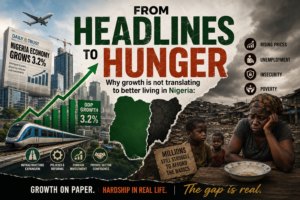
In Nigeria, we are seeing a version of that same paradox. The country has entered what First Bank calls a new phase in its Mid-Year Economic and Market Outlook 2026. After two years of tough reforms, macroeconomic indicators have stabilised. External reserves climbed to $51.46 billion as of June 30, 2026. Liquidity in the official foreign exchange market has improved. Capital importation rose to $10.37 billion in the first quarter of 2026, an 83.8% increase year-on-year. Refined petroleum exports jumped 20.3% to $2.37 billion, helped by the 650,000-barrel-per-day Dangote Refinery. On paper, the numbers suggest recovery and momentum.
But on the streets, in markets, and in homes, the feeling is different. Inflation remains elevated. The cost of food, transport and electricity is still squeezing households. Financing is still tight for small businesses. And jobs are not coming fast enough. This is why growth is not immediately translating to higher standards of living.
Part of the reason is the kind of growth we are seeing. Much of it is coming from capital-intensive sectors like refining, banking, telecoms and portfolio investment. These areas create value and foreign exchange, but they do not create mass employment.
The Dangote Refinery and the financial markets can add billions to GDP without hiring millions of Nigerians. Meanwhile, the real job engines — agriculture, manufacturing and MSMEs — are still battling high energy costs, insecurity, and limited access to credit. Youth unemployment remains above 30%, and for many young people, the promise of reform has not yet shown up in payslips.
The second reason is inflation. The same policy adjustments that helped stabilise the naira and rebuild reserves — subsidy removal, exchange rate unification, tighter monetary policy — also pushed prices up sharply between 2022 and 2024. First Bank itself cautioned that “the benefits of improved macroeconomic stability have yet to fully filter through to businesses and households.” Stability in a central bank report does not mean relief in a market. Until wages and purchasing power catch up, people will not feel that the economy is better, no matter what the reserves say.
The third reason is distribution. Like the growth in Morocco that is concentrated in Casablanca and Tangier, Nigeria’s gains are concentrated in Lagos, Abuja and a few other hubs. Capital is flowing into tech, finance and oil and gas, but rural communities and smaller cities are largely left out. The result is what economists call “growth without inclusion.” GDP can rise while a large share of the population sees no change in their daily lives.
Senator Sani’s post about Morocco is a reminder that headlines do not automatically equal hope. The real test of economic reform, as First Bank noted, is no longer stability itself but “the extent to which that stability begins to strengthen productive economic activity, stimulate private investment and deliver broader improvements across the real economy.” For the second half of 2026, the focus will have to shift from just managing indicators to converting those gains into jobs, lower prices, and opportunity across the country.
For Nigeria, the measure of success will not be how big reserves get, or how much is exported. It will be whether a young graduate in Warri, Benin City, Enugu, Kaduna or Port Harcourt can find work without leaving the country, whether a trader in Kano can afford her stock, and whether a farmer in Benue can get his produce to market without the cost eating all his profit. Until growth shows up in those places, it will remain a headline that many Nigerians cannot feel. And that, as the images from Morocco showed, is when people start looking for another way out.