


Three years ago, author Barry Hoffner traveled to Iran and found a starkly different experience than what Western media has long depicted
As headlines fill with news of war in Iran — missile strikes, rising tension, a region once again framed through conflict — I find my thoughts drifting elsewhere. Not to strategy or geopolitics, but to people. Because when I traveled to Iran exactly three years ago, what I experienced felt closer, more real, and harder to reconcile with the story being told.
In late 2017, I lost my wife, Jackie, in a tragic accident in Africa — a continent whose people and landscapes had captured our hearts many years earlier. After she died, I found I could not remain in a house defined by her absence. Eventually, I understood that I had a choice: to retreat, or to keep going. Loss has broken me, but I chose movement as a way to find healing — and it did.
What began as escape slowly became something else. I set out to visit every country in the world — even those I had been warned against. Iran was one of them.
But Iran was not just another destination.
It was a place Jackie had long imagined. When she was studying biology at UC Irvine, she became close with a group of Persian classmates who folded her into their lives — sharing meals, long nights studying, fragments of a culture that stayed with her. She spoke about Iran often, in the language of warmth, hospitality and food.
We once tried to go. I was working in neighboring Armenia; she was a few months pregnant with our son, Benjamin. We applied for visas and were denied. In 2023, years after her loss, I found myself going alone, carrying that unfinished plan with me.
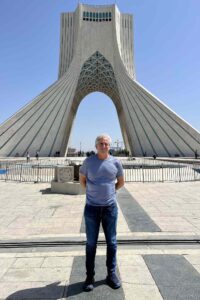
Before I arrived, I held the same familiar impressions many Americans do — revolution, hostility, risk. Even the logistics of the trip reinforced them: precautions, small adjustments, a sense of entering a place defined for decades by adversarial relations between our countries.
But on my first evening in Tehran, those impressions began to loosen.
It was dusk when I walked through a park where families had gathered. The light was soft. Snow-covered mountains hovered in the distance, almost improbably close. A bridge lit up the skyline. Boys skateboarded across the pavement. Elderly couples sat talking on benches. There was the low, constant hum of conversation, the clink of tea glasses.
I sat down with my guide, Babak, at an outdoor restaurant and looked around, trying to reconcile what I was seeing with what I thought I knew. Nothing seemed out of the ordinary other than the experience of a new place. That, perhaps, was what stayed with me most.
The next day, moving past mosques, palaces and the Grand Bazaar, I found myself searching for signs of the instability I had expected. But what I encountered was something harder to categorize: a city in motion, people going about their lives, cafés full, conversations unfolding. I felt a gulf open between my long-held narrative of Iran and the experience I was having.

In Isfahan, that feeling deepened.
They call it “Half the World,” a name that might seem like exaggeration until you walk there. Tree-lined paths opened into wide squares. The air carried the softness of early spring. People lingered in the evening light.
At the Khaju Bridge, illuminated at night, I noticed a young couple partially hidden behind a column. They leaned into each other, briefly, carefully. The woman was not wearing a hijab. It was a small moment. Easy to miss. But it seemed to hold something essential — a life lived not only within rules, but alongside them. A negotiation between what is required and what is desired. I began to notice those negotiations everywhere.
In Shiraz, I got my haircut in a local barbershop, something I like to do in exotic locations, by a young man with a kind smile. Neither of us spoke the other’s language but through smiles and hand gestures, we found connection.
Iran did not feel like a contradiction so much as a place layered with realities that do not resolve neatly. History, politics, religion, modernity are all present at once, sometimes in tension, sometimes simply coexisting.
What I had understood about Iran before going was not exactly wrong. It was just incomplete. My experience added real impressions to my mind’s map of this complex place. And perhaps that is always the case.
It was also, in a way, a continuation of something Jackie had started. Walking those streets, I was aware of both her absence and her presence — of the distance between what we had planned and what I was now experiencing alone. And yet, there were moments — unexpected, unremarkable in themselves — when that distance seemed to narrow. In conversation with Iranians, in the generosity of strangers, in the familiarity of something I had only ever heard described.
Now, as the news fills again with images of conflict, I find myself returning to those earlier impressions. Not to dispute what is happening, but to remember what exists alongside it.
I think of that park in Tehran. Of tea shared across a table. Of conversations that moved easily, without the weight of the stories that surround them from a distance. The same place now described in terms of escalation and consequence is also a place where people wake up, go to work, meet friends, fall in love. Having been there, it becomes harder to see Iran as a single idea. It resists that kind of simplification.
Travel, I’ve come to realize, does not erase the realities we read about. But it does make them harder to hold in isolation. It introduces other truths that rarely make it into headlines. Real connections with people — something that was a lifeline after my own personal loss — reminded me that even in places defined by conflict, humanity is never abstract.
Connection, it turns out, is less elusive than we imagine, and often life-affirming.
Credit: People