

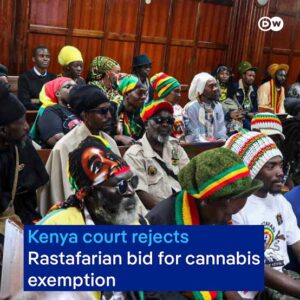
Kenya’s High Court has dismissed a petition by the Rastafari Society of Kenya seeking a legal exemption to use cannabis for religious purposes, ruling that the country’s drug laws do not violate the constitutional right to freedom of religion.
In a judgment delivered on Thursday, Justice Bahati Mwamuye said the group had failed to prove that the ban on cannabis infringed its rights, though he acknowledged the issue warranted broader public debate.
The Rastafari Society argued that cannabis is a sacred sacrament in their faith and asked the court to allow followers to cultivate, possess and use it privately in homes and places of worship without risk of arrest.
Lawyers for the society said the practice was an essential part of Rastafarian doctrine and should be protected under Article 32 of the Constitution, which guarantees freedom of religion and belief.
The state opposed the application, telling the court that a religious exemption would undermine enforcement of anti-narcotics laws and could be exploited for trafficking.
Justice Mwamuye found the evidence presented by the Rastafarian community “inconsistent and insufficient” to show that cannabis use was an indispensable practice of the religion.
He therefore upheld the constitutionality of the Narcotic Drugs and Psychotropic Substances (Control) Act, which criminalizes the cultivation, possession and use of cannabis.
Under the law, possession for personal use carries up to 5 years in prison or a fine of up to 100,000 Kenyan shillings, about $800. Cultivation attracts up to 20 years in prison or a fine of up to 250,000 shillings, or three times the market value of the crop.
The ruling brings to an end the society’s six-year legal challenge.
While dismissing the petition, the judge said the debate should not end in court.
“We ought to have frank conversations on cannabis and which directions we should take,” Justice Mwamuye said. “This is not a question for the Rastafarian community only. It is a national question that cuts across the entire spectrum of our society.”
Danstan Omari, lawyer for the Rastafari Society of Kenya, said the group would appeal.
“Kenya cannot be the only country that is harassing the Rastafarian people. We are determined to reverse that court ruling and bring back the dignity and respect of the Rastafarians in Kenya,” he said.
The case comes seven years after the High Court recognized Rastafarianism as a protected religion in Kenya and ruled that a school’s expulsion of a student over dreadlocks violated her rights.
There are no official figures for the number of Rastafarians in Kenya, but the movement is seen as growing, especially among young people. Dreadlocks also carry historical weight in Kenya, associated with Mau Mau fighters during the 1950s struggle against British colonial rule.