

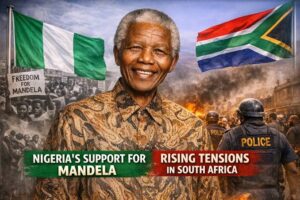
Social media posts by Nigerians this week have resurfaced the country’s financial and diplomatic support for South Africa’s anti-apartheid movement, with many referencing the 1970s “Mandela Tax” amid current xenophobic and diplomatic tensions.
The posts recall the Southern Africa Relief Fund, SARF, established in 1976 under military ruler General Olusegun Obasanjo. According to the posts, all Nigerian civil servants and public officers were mandated to contribute 2% of their monthly salaries to support liberation movements in southern Africa.
Students also reportedly donated allowances to the fund.
Supporters of the posts said SARF raised $10.5 million within six months by June 1977. They added that Obasanjo’s administration contributed $3.7 million, with personal donations of $3,000 from the General and $1,500 from each cabinet member. The posts also cited an estimate that Nigeria spent about $61 billion between 1960 and 1995 on the anti-apartheid struggle, funding relief for victims, educational scholarships, and liberation groups including the African National Congress, ANC, and the Pan Africanist Congress, PAC.
*Broader Nigerian role documented*
Nigeria’s opposition to apartheid is well documented by historians. The country broke diplomatic ties with South Africa in 1961, imposed trade sanctions, and provided diplomatic support for UN resolutions condemning the apartheid regime. Nigerian universities also offered scholarships to thousands of South African students exiled during the struggle.
“From the 1960s to 1994, Nigeria was one of the most consistent supporters of liberation movements in southern Africa,” said Prof. Adekeye Adebajo, director of Centre for Conflict Resolution in Cape Town, in previous research on the subject. Independent verification of the total $61 billion figure cited in social media posts was not immediately available, as comprehensive records of all military and civilian-era spending have not been published.
*Current reactions*
The resurfacing of SARF posts comes as Nigerians online express frustration over recent xenophobic incidents and diplomatic disputes involving South Africa. One of the posts ended with an appeal: “Is this how to appreciate those that suffered for your freedom?”
Nigeria and South Africa remain Africa’s two largest economies and have cooperated on trade, security and regional diplomacy through the African Union and ECOWAS. Both governments have previously condemned xenophobia and pledged to protect nationals of each country.