

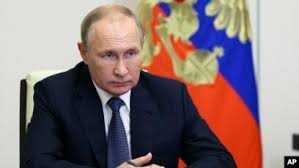
The Hague-based ICC accused the Russian president of responsibility for war crimes committed in Ukraine. How to successfully extradite Putin to face trial could prove a far greater challenge.
The International Criminal Court has issued an arrest warrant for Russian President Vladimir Putin, over responsibility for war crimes committed by Russian forces in Ukraine during the war ongoing for over a year.
The court’s accusation centered around the alleged deportation of Ukrainian children to Russia. Moscow said the warrant had no legal bearing on the Russian president.
What do we know about the warrant?
The ICC’s chief prosecutor Karim Khan said his office identified incidents of deporting “at least hundreds of children” taken from Ukrainian orphanages and children’s care homes. Many of the children are alleged to have been offered for adoption in Russia since.
Khan referred to a legal amendment, based on presidential decrees, which essentially facilitated the adoption of the children by Russian families.
“My office alleges that these acts, amongst others, demonstrate an intention to permanently remove these children from their own country,” Khan said. “We cannot allow children to be treated as if they are the spoils of war.”
The Hague-based court said there were reasonable grounds to believe that Putin “committed the acts directly, jointly with others and/or through others,” or that he failed to properly control “civilian and military subordinates who committed the acts, or allowed for their commission, and who were under his effective authority and control, pursuant to superior responsibility.”
The court did not elaborate on how it intended to carry out the warrant. Russia tends not to cooperate with international extraditions, is not a full member of the ICC, and does not accept its jurisdiction.
The ICC also issued an arrest warrant for Maria Lvova-Belova, Russia’s Presidential Commissioner for Children’s Rights, on the same charges Putin was facing.
Russia says warrant ‘has no meaning’
Russia’s Foreign Ministry quickly undermined the significance of the warrant. Spokeswoman Maria Zakharova said the decision had “no meaning for our country, including from a legal point of view.”
“Russia is not a party to the Rome Statute of the International Criminal Court and bears no obligations under it,” she said in a statement on the messaging app Telegram.
The Kremlin said it did not recognize the ICC’s authority, with Kremlin spokesman Dmitry Peskov saying that any of the court’s decisions regarding Russia were “null and void.”
Peskov added that Russia found the questions raised by the warrant “outrageous and unacceptable.”
Former president and Putin-confidante Dmitry Medvedev also ridiculed the impact of the arrest warrant.
“No need to explain WHERE this paper should be used,” Medvedev wrote, using the toilet paper emoji on Twitter.
Though it initially signed the Rome Statute in 2000, Moscow never ratified it to become an ICC member. In 2016, under pressure due to its annexation of Crimea from Ukraine and air strikes in Syria, Russia withdrew its ICC signature.
Ukraine also has not ratified the Rome Statute. However, Kyiv has twice accepted the court’s jurisdiction over alleged crimes on its territory regarding Russia’s 2014 Crimea annexation and the events both leading up to it and resulting from it.
Ukraine welcomes the warrant
Ukrainian officials were quick to welcome the news, with Prosecutor General Andriy Kostin hailing it as a “historic decision.”
“The world received a signal that the Russian regime is criminal and its leadership and henchmen will be held accountable,” he said.
Andriy Yermak, the head of Ukraine’s presidential office, described the warrant as “just the beginning.”
Ukrainian Foreign Minister Dmytro Kuleba also applauded the ICC decision.
“International criminals will be held accountable for stealing children and other international crimes,” he wrote on Twitter in response.