

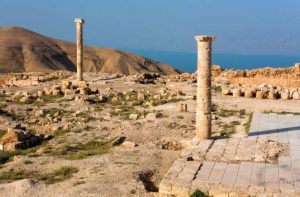
The clifftop palace with a view of the Dead Sea, where Princess Salome is said to have danced before Herod Antipas’ court and demanded John the Baptist’s head, is being reconstructed
The throne room where Salome is said to have danced before the king Herod Antipas has been discovered at the Dead Sea fortress at Machaerus, Jordan. The archaeologists are in the process of partially reconstructing the monarchical site in the palace built by Antipas’ father Herod the Great – apparently as an upgrade of a stronghold originally erected by the Hasmonean king Alexander Jannaeus in around 90 B.C.E.
The Machaerus stronghold was erected 32 kilometers southwest of Madaba over 2,000 years ago on a cliff with a view of the Dead Sea – and on clear days, of the temple in Jerusalem. Rabbinic writings report that the smoke of the sacrificial offerings could be seen rising from the altars of the temple in Jerusalem all the way in Machaerus (Mishnah 3, Tamid 3.8).
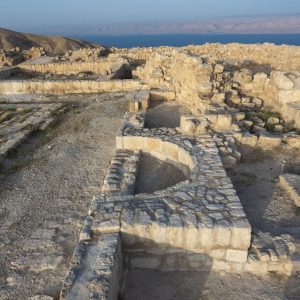
Inside the 7,000-square-foot royal courtyard, archaeologists have identified a semicircular niche where they believe the throne was positioned.
The main source of information about the Herodian dynasty is the Roman-Jewish historian Flavius Josephus, who lived in the first century C.E. According to him, the Herods were Jews, at least nominally, because their people – the Idumeans – had circumcision forced upon them by the Maccabean ruler John Hyrcanus I in about 125 B.C.E.
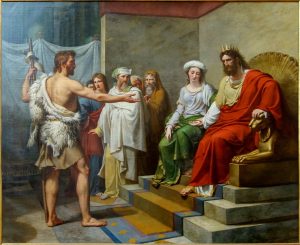
The true history of the Herods is lost in time, but Josephus tells that the Hasmonean king Alexander Jannaeus appointed one Antipas to rule Edom, who would father the dynasty. Herod the Great would become famed for his construction efforts; his son Herod Antipas would become famed for, allegedly, bringing John the Baptist to Machaerus in chains and putting him to death.
Machaerus was of critical importance to the defense of Judea, being en route to Jerusalem from the east. The historian Pliny the Elder called Machaerus “the strongest fortification in Judea” after Jerusalem (Historia Naturalis, V. 15, 16).
And it was more than that: When upgrading the stronghold into a palace, Herod built a Roman-style bath, a triclinium for feasting, and a formal courtyard with a peristyle, aka a small royal garden, surrounded by porticos on four sides – one of which contained the apsidal structure marking the place of King Herod’s throne. He would pass this palace onto his son, the tetrarch Herod Antipas.
Archaeological investigation of the Machaerus courtyard began in 1980. The area of the Herodian throne had remained unexplored. Now recent excavations by a Hungarian Franciscan team led by Professor Gyz Vörös have unearthed the foundations of the Herodian throne.
The original floor level is lost. However, the archaeologists suspect that the throne sat on an elevated platform accessible by stairs.
Last year the archaeologists dismantled the modern wall in front of the freshly restored apsidal throne niche and excavated the throne hall to the bedrock, Vörös says and have been working on restoring the apsidal throne niche.
“During our excavations we have corrected many of the false archaeological reconstructions from previous excavations,” Vörös says.
The team has also re-erected two of the columns that had once held up the roof of the courtyard where the princess Salome is said to have danced.
Where Salome danced
Josephus relates that Machaerus was where the princess Salome danced at the birthday banquet of in honor of her stepfather, Herod Antipas (Antiquities 18.116–119). So delighted was Herod at her performance that he promised her anything she requested—up to half his kingdom.
At her mother’s advice, according to the gospel version, Salome asked for the head of John the Baptist.
Though distressed, Herod, “out of regard for his oaths and for those reclining with him commanded it to be given; and he sent and had John beheaded in the prison. And his head was brought on a platter and given to the maiden, and she brought it to her mother.” (Matthew 14:1-11. Mark 6:17-28.)
The Christian historian Eusebius later (324 C.E.) also tells the story of Machaerus (Ecclesiastical History 1.11.4–6).
“Josephus’ history together with the biblical literary sources are in full harmony with the archaeological research and excavations of Machaerus,” Vörös says. “In fact, the architectural legacy and the archaeologi-cal materials, including epigraphic, ceramic, and numismatic evidence, all fully agree with the detailed description of Josephus.”
Where John was killed
According to Josephus, John the Baptist was brought to Machaerus in chains and put to death (Jewish Antiquities, Book 18, chap. 5, par. 2 [Loeb 18.119]).
The excavation team are currently excavating the houses of the Herodian lower city of Machaerus, in which John the Baptist was supposedly imprisoned. After being executed by one Antipas’ bodyguards (Mark 6:27–28; Matthew 14:10), the Baptist may have been buried in the Machaerus necropolis.
His grave has been lost. However: “We are confident that we will be able to uncover the last details of this biblical drama,” Vörös says.
For all its strength, Machaerus was destroyed in 71 C.E. by the same Roman legion that captured Masada from the Jewish zealots, the Tenth Roman Legion. In both cases the Romans built a siege ramp to gain access, though in Masada’s case at least, argument rages to this day about what really happened there.
Thus ended the settlement in Machaerus that, within its walls, had hosted five figures from the Bible: King Herod the Great; his son, Tetrarch Herod Antipas; his second wife, Princess Herodias; her daughter from a previous marriage, Princess Salome and John the Baptist. And now, 2,000 years after the event, the site features a memorial to Prophet Yahya Bin Zakariyya – aka, John the Baptist.