

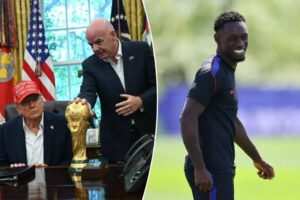
World football was thrown into controversy on Wednesday after reports emerged that a call, allegedly from Trump, led to the rescinding of a disciplinary decision taken against a player at the World Cup.
If confirmed, the incident would mark the first known case of direct political intervention overturning a FIFA disciplinary ruling during a World Cup tournament.
Sport’s governing bodies have long operated on one core principle: that rules on the pitch, and sanctions off it, are decided by statutes and judicial panels, not by political office.
That separation exists to protect the integrity of competition. The moment political power is seen to reach into disciplinary outcomes, the game stops being governed by laws and starts being governed by access.
FIFA’s Disciplinary and Appeal Committees are designed to function independently of member associations and governments. Article 19 of the FIFA Statutes explicitly prohibits third-party interference in the affairs of member associations.
Officials and former players warned that allowing one leader to intervene successfully sets a precedent every other government will seek to follow.
“We quickly move from a system of rules to a system of influence,” one senior football administrator said on condition of anonymity. “The fear now is that FIFA ends up with its own version of a UN Security Council — a tier of permanent members whose calls carry more weight than the rulebook.”
The risk extends beyond football. The IOC, World Athletics, World Rugby and other international federations all rely on autonomy to shield referees and judicial panels from political pressure.
Once that principle is breached in a high-profile case, it becomes harder to defend elsewhere. A yellow card, a doping ban, a stadium closure — all could become subjects of diplomatic calls instead of legal process.
That, officials said, undermines the founding idea of international sport: that a small nation and a large nation are equal before the rules.
FIFA had not issued a public comment on the specific allegation as of Wednesday evening.
The response will now be watched closely. If the disciplinary process is allowed to stand, the message will be that statutes matter more than the caller ID. If it is changed after political intervention, the message will be remembered the next time a decision does not go a powerful country’s way.
Senator Shehu Sani, responding to the development wrote via X:
“If a President of a Country can call the FIFA President to interfere or change a disciplinary decision that has been taken on a player,a dangerous precedent has been set for international sports officiating,not just football administration in the World.I hope FIfa will not have its own UN style permanent members security council.”
“The credibility of the game rests on the idea that the referee’s whistle, and the panel’s ruling, are final — not subject to a call from a capital city,” one former FIFA executive said.
Because once we start planting trees whose shade only some leaders get to sit in, the rest of us are left standing in the sun.