

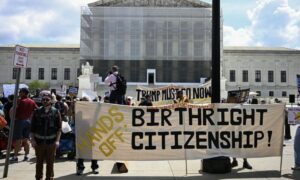
The United States Supreme Court on Tuesday invalidated former President Donald Trump’s executive order seeking to restrict birthright citizenship, holding 6-3 that the 14th Amendment mandates citizenship for virtually all children born on U.S. soil.
Chief Justice John Roberts, writing for the majority, said the guarantee applies to children of undocumented immigrants and of non-citizens lawfully present on temporary visas.
“Citizenship, then and now, was the right to have rights — to freely participate in our political community. The Framers of the Fourteenth Amendment extended that promise to ‘every free-born person in this land’,” Roberts wrote. “We keep that promise today.”
Hours after returning to office in January, Trump signed an order ending what he called the “birthright citizenship privilege”. The White House argued that foreign nationals were travelling to the U.S. to give birth in order to secure citizenship for their children, a practice officials termed “birth tourism”.
Federal courts swiftly blocked the order with nationwide injunctions. The administration pressed ahead, warning of strict penalties and urging consular officers to scrutinise visa applications. In July, the U.S. Embassy in Nigeria said applications would be denied if officers had reason to believe birthright citizenship was the principal motivation for travel.
Ratified in 1868 after the Civil War, the 14th Amendment states: “All persons born or naturalised in the United States, and subject to the jurisdiction thereof, are citizens of the United States”.
For more than a century, the provision has been interpreted to cover children born in the country, save for narrow exceptions such as children of foreign diplomats.
Trump maintained that the clause was being exploited and that only a change in policy could curb migration. Tuesday’s ruling means the executive order cannot stand. Constitutional scholars said the only remaining avenue to alter the rule would be a constitutional amendment, a process requiring two-thirds approval in Congress and ratification by three-quarters of the states.
The decision is a major setback for Trump’s immigration platform, which has centred on reducing irregular migration and limiting benefits to non-citizens. Immigrant rights groups welcomed the judgment as a defence of a “foundational principle of American democracy”.
Trump had not issued a formal response by press time. In remarks ahead of the ruling, he lashed out at the judiciary, saying judges he had appointed but who voted against him were “stupid people”.
Civil liberties advocates said the ruling preserves access to education, healthcare and other rights tied to citizenship for hundreds of thousands of children each year. Critics of birth tourism argued the court missed an opportunity to address what they describe as a loophole in immigration law.
With the order struck down, federal agencies are expected to revert to pre-January guidance on birth certificates and citizenship documentation for newborns in the United States.