






- Leader of four-week mission in Wuhan says initial findings suggest virus was introduced to humans through an intermediary host species
- Believe it may have escaped from a laboratory ‘extremely unlikely’
World Health Organization investigators looking into the origins of
Covid-19 in China have said it was most likely that the virus spread to people via an intermediary animal and ruled out the possibility that it came from a laboratory leak.
The leader of the mission, WHO food scientist Peter Ben Embarek, shared the findings of the nearly four-week mission in a closing press conference on Tuesday evening from Wuhan, where he spoke alongside senior Chinese health official Liang Wannian and Dutch virologist Marion Koopmans.
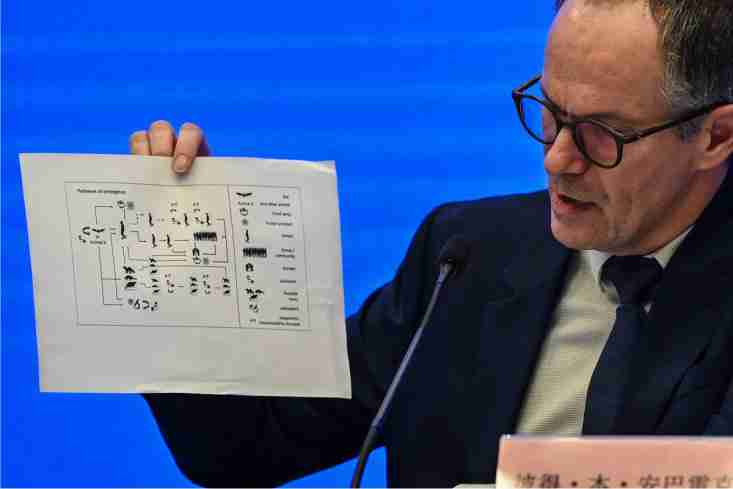
“Our initial findings suggest that the introduction through an intermediary host species is the most likely pathway and one that will require more studies,” Ben Embarek said, noting this was more likely than the virus directly jumping over from a bat – believed to be the animal the virus originated from – into people in Wuhan.
The “laboratory introduction hypothesis” on the other hand “is extremely unlikely to explain the introduction of the virus into the human population”, he said, referring to theories that the virus may have escaped from a Wuhan laboratory studying coronaviruses.
The team visited local laboratories, including the Wuhan Institute of Virology, as part of their itinerary in Wuhan and discussed biosafety protocols and details of past research with staff, Ben Embarek said.
He also referred to a theory, which has been backed by some Chinese scientists that the virus could have entered into Wuhan via frozen goods, noting that this was a possibility, though less likely than an introduction via an intermediary host.
The 14-person international team of virologists, doctors and animal health specialists has been in Wuhan since January 14 working with Chinese scientists to review data in the city where the virus was first detected in late 2019.
While the team enhanced their understanding of what the early spread of the disease was like in Wuhan in December, according to Ben Embarek, it remained unclear how the virus first began spreading in the city and in the Huanan seafood market, which was linked to a number of the early cases.
Similarly, testing for the coronavirus in animal species throughout the country, including domestic, farmed and wild animals indicated there was no widespread circulation of the virus in any animal species now or in 2019, he said.
Ben Embarek said more should be done to understand the role of cold chains. He also called for continued research into the kinds of animal products that were on sale in the Huanan market in December 2019, as well as exploring evidence that has arisen around the world.
“It’s very interesting to follow up on every one of these clues, and preliminary reports and indications [of early infections] … around the world, and connect the dots and connect the different pieces of information to try to get a better understanding of this whole picture,” he said.